Tanker Sizes Explained
Understanding the Global Oil Tanker Classifications
Size Defines Capacity. Scale Drives Trade.
Oil tankers are the backbone of global energy trade, transporting more than 90% of the world's seaborne crude oil. Tanker sizes are classified by their deadweight tonnage (DWT), which indicates the maximum weight the vessel can carry when fully loaded.
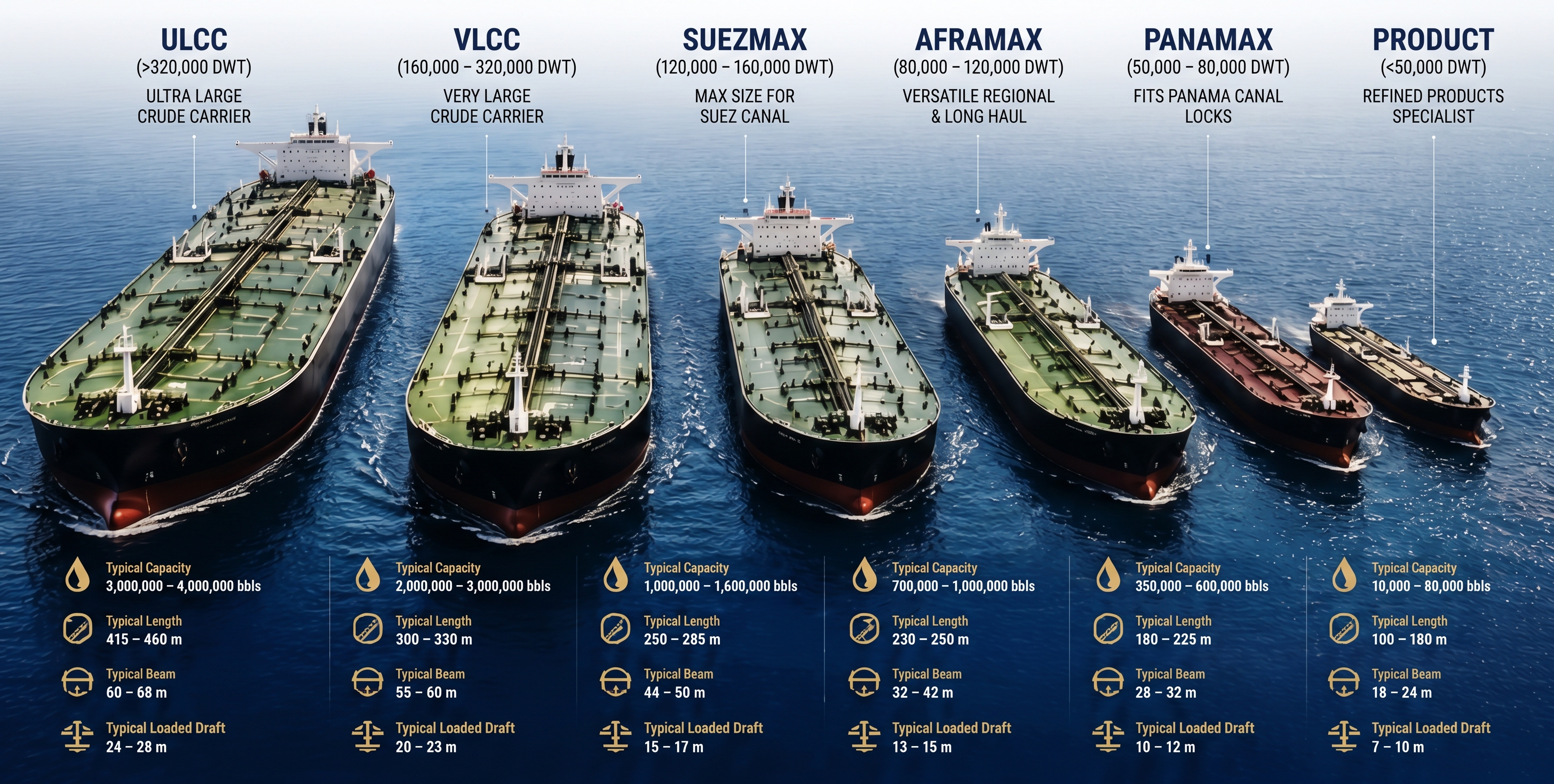
Comprehensive Overview
| Tanker Class | DWT Range | Typical Capacity (barrels) | Length (m) | Beam (m) | Loaded Draft (m) | Key Features | Primary Trade Routes | Typical Charter Use |
|---|---|---|---|---|---|---|---|---|
| ULCC | >320,000 | 3,000,000 - 4,000,000 | 415 - 460 | 60 - 68 | 24 - 28 | Giant crude carriers, highest capacity, deepest drafts | Middle East - Asia, US Gulf - Asia | Long distance, intercontinental |
| VLCC | 160,000 - 320,000 | 2,000,000 - 3,000,000 | 300 - 330 | 55 - 60 | 20 - 23 | Industry workhorse, flexible, high volumes | Global deepwater routes | Spot and long term contracts |
| SUEZMAX | 120,000 - 160,000 | 1,000,000 - 1,600,000 | 250 - 285 | 44 - 50 | 15 - 17 | Max size for Suez Canal, port flexibility | Suez Canal, Atlantic Basin, Med | Regional & inter-basin trades |
| AFRAMAX | 80,000 - 120,000 | 700,000 - 1,000,000 | 230 - 250 | 32 - 42 | 13 - 15 | High versatility, access shallow ports | Europe, Med, West Africa, Asia | Regional & niche routes |
| PANAMAX | 50,000 - 80,000 | 350,000 - 600,000 | 180 - 225 | 28 - 32 | 10 - 12 | Fits Panama locks, coastal access | Panama Canal, US, Latin America | Short haul & coastal trades |
| PRODUCT | <50,000 | 10,000 - 80,000 | 100 - 180 | 16 - 24 | 7 - 10 | Specialized for clean products & chemicals | Global refined products distribution | Refined products & chemicals |